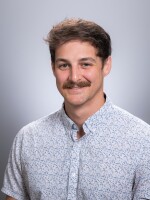
In truth and in fiction, Delaney Nolan's debut novel began with disaster. It was summer 2016, and catastrophic rainfall had submerged Baton Rouge.
Nolan was in New Orleans, watching the aftermath unfold while working on what would become a book about institutional care, climate collapse and the dark absurdities of trying to survive in a world that's simultaneously breaking down and pretending everything is fine.
Eight years and three complete rewrites later, “Happy Bad” arrives as something harder to categorize than just climate fiction or Southern Gothic, though it contains elements of both. The novel follows staff and residents of a treatment center for teenage girls in East Texas as they evacuate across the Gulf South during a catastrophic heatwave and electrical grid failure. The scenario felt speculative when Nolan started writing, but now reads as if it could happen in the near future.
What makes the book particularly unsettling is how much of it Nolan didn't have to imagine. As an investigative journalist covering heat deaths, pharmaceutical exploitation and coastal land loss, she's spent years reporting on the very systems of neglect and bureaucratic cruelty that drive her fiction.
In this conversation with the Gulf States Newsroom’s Drew Hawkins, Nolan discusses the journey of writing “Happy Bad,” how her journalism informs her fiction (and vice versa), why it was crucial to make a book about disasters funny and what she learned about hope while reporting in places touched by disaster.
The following is an extended transcript of Hawkins' conversation with Nolan. It has been edited and condensed for clarity.
DREW HAWKINS:
Hi Delaney, thanks for sitting down with me today.
NOLAN: Hey, Drew, thanks so much for having me!
HAWKINS: First of all, congratulations on your first novel. It's essentially a road trip from Texas to Atlanta. Can you take us through the journey of the book itself — when you started it, how it changed and how it evolved to its final published form?
DELANEY NOLAN: I think I wrote probably like three books in the course of writing this one book, because so much of it you write and then you realize, OK, this piece doesn't quite fit in here. So I'm gonna take it out. I'm going to rewrite things. They actually don't need to go to this wedding in the desert. I'm going to cut that whole section.
I started the book summer 2016, which feels like a million years ago. It was around the time of all the flooding in central Louisiana, around Baton Rouge, and I was in New Orleans at the time. So that's part of how it started.
The other part that inspired it is, I had just come from getting my MFA at the Iowa Writers Workshop, and while I was there, I was volunteering at a residential treatment center for teenage girls, sort of like the institution that's represented in this book. After leaving Iowa and spending the summer in New Orleans, I ended up doing a Fulbright in Greece, in Thessaloniki. This was right around the peak of the Syrian refugee crisis, so I ended up working at a refugee reception center there for several months.
In both the residential treatment center for teenage girls in Iowa and the Syrian refugee camp in Greece, there was kind of this weird parallel, which is part of what I was interested in exploring in this book — how at these places that are meant to be helping really vulnerable and marginalized people, sometimes we see these same systems of control being replicated.
They're meant to protect people and keep them safe, but they end up doing the same types of harm, both to the people who were staying there and to the people who were working there. That was sort of, in a really big, broad sense, some of the things I was interested in writing about over the years that I was working on this book. And then just being in Louisiana and being in New Orleans was constantly shaping and pushing and pulling at it.

HAWKINS: Place and setting are huge here. The book really blends a lot of dark humor with disaster, decay and grotesque representations. There's also social critique. And there are moments that are actually just funny — I'm actually laughing as I'm reading it. How do you categorize the book, and how did you work to strike that balance between dark humor and disaster while still keeping emotional depth?
NOLAN: I love the idea of thinking of it as Southern Gothic. I think it's maybe not as classically Anne Rice-dark enough to fit what we would normally think of as Southern Gothic, but trying to be at least a little bit funny was honestly so important.
A lot of the cycles of revision that I would go through, like a good part of the focus was to try to keep that humor, at least a little bit of buoyancy or unpredictability or motion that sometimes you would lose if you're writing a scene that is sort of dark or where the characters are struggling.
HAWKINS: Why was it important to be funny?
NOLAN: There's so much absurdity around some of the ways that we move through disasters and the way bureaucracies show up in the wake of these disasters that there just is a lot of weird, funny stuff that happens.
But also, when you begin a book that is maybe trying to be a little heavy at points, we just can't start by trying to pull your heart out from page one. I think you have to make people laugh a little bit at first before you can upset them later. You need to pull people in by being a little funny, and then you can make them cry, hopefully at the end.
I remember sharing an early draft with a friend of mine, and she was like, "It's pretty good, but it's totally devoid of hope, which nobody wants to read. It's a little hard to get through." And it's also just not realistic.
I don't think there are that many situations in which a person can feel discouraged and hopeless, but I don't think it's often that a people, a culture, comes to the end of hope or the end of humor. So it did, for my own sanity's sake and for the sake of readability and for realisticness, need to be kind of funny.
HAWKINS: There's a moment that's really particularly visceral for me — this scene where the group gets held up at the Louisiana-Mississippi border, and they stop at a rest area and they almost instantly get heatstroke. I know that you've covered stories about the health impacts of extreme heat. As a writer, were you thinking through these things that you're seeing now and then taking them to their extreme, but also maybe logical conclusion?
NOLAN: Yeah, in some ways. I was actually finishing edits for this book right before the summer of 2023, which was like our scary, crazy-hot summer where it really, genuinely was scary to go outside.
I was reporting on heat deaths of people without housing in New Orleans, and meanwhile, my air conditioner at the place I was living wasn't strong enough for the house. So I was talking to experts on heat deaths about what would happen — your heart starts working harder to push sweat up to the surface of your body to cool you down, and you're getting dehydrated, and it can cause brain fog and all these problems.
And meanwhile, it's like 85, 90 degrees in my house, and I'm dumping sweat, my heart is pounding, and I'm feeling crazy and anxious because your body is like, "Oh, I'm in trouble, I'm freaking out, my heart is pounding, it must be anxious, there must be something wrong."
I think there are some cases in which specific parts of journalism, parts of research and reporting show up — like the way it feels to experience scary heat. And then just by virtue of living here, it would also show up.
I think in a larger sense, doing some journalism reporting here and also organizing with a group called Southern Solidarity before I got into journalism left me with a better sense of how these larger systems that are meant to nominally protect us end up creating barriers or snagging us with having to navigate bureaucracy in such a way where eventually we feel like the things that are being done to us are a result of our own failures. Like anyone who's had to deal with a health insurance company has gone through that. So in a larger way, it felt like the world I was looking at was just a sort of natural continuation of the ways that we've been going.

HAWKINS: You are an investigative journalist in the real world. I'd love to hear how your reporting informs your fiction.
NOLAN: Some of the stuff that's in here, like just the very concept of Louisiana land loss, was something that I was interested in writing about and writing fiction about before I ended up doing any journalism reporting on it.
HAWKINS: You get on a lot of rabbit holes when you're writing fiction, too, because you have to do some sort of research, like it's going to be involved and you're going to look into something. But I think maybe your rabbit holes sometimes ended up being published, you know?
NOLAN: Yeah, it's kind of why I ended up going into journalism. You know how sometimes you go down these rabbit holes for fiction, and you're just like, this is so crazy, this is so interesting, and you end up shoehorning it into your fiction writing where maybe it doesn't belong there? Or you have to...
HAWKINS: Or you have to kill it ultimately. It doesn't actually make it in.
NOLAN: But journalism ended up giving me this bucket to put the true things in, where if I go down a rabbit hole, it is just too amazing and interesting for me to let go. It turns out I can report on it. And there are some pretty concrete ways in which it informs some of the writing.
So the first, very first reporting I did was in the wake of 2021's Hurricane Ida. And like a lot of people, I went down to Terrebonne Parish and was bringing some supplies — a generator, toilet paper, and other things to people down in the bayou who got hit really hard. And I ended up talking to Chief Shirell Parfait-Dardar, who at the time was the chief of the Grand Caillou/Dulac Band of Biloxi-Chitimacha-Choctaw. And she was telling us about how they lived there for generations, but just in her lifetime, she had seen the land retreat and the trees die back. And eventually they were going to have to move. But she and the rest of the tribe did not really trust the government, local or federal, to manage that retreat for them. So they're going to do it on their own.
In the book, after my friend was like, "You know, this book is totally devoid of hope," the other thing that she and I talked about was how on these margins, in these forgotten, neglected places like the bayous of Louisiana, other things become possible, other ways of living, other methods of community become possible and things also widely open up. And that became sort of the linchpin for the ending of the book. Whereas before it was much bleaker, the things that I learned down in Terrebonne Parish, I think, opened up a way for the book to, I hope, have an ending that makes room for better possible things.
HAWKINS: I really want to come back to this idea that you've mentioned a couple of times, of hope, and with the ending, where they find themselves in a community that gives them hope and closure, sort of. There's a common trope in environmental articles or journalism where, towards the end, it goes to, "But if we do this, if we take this action, then the thing I've just described might be a little better." That's not how I felt reading the end of this. It's more like, OK, well, in light of all of this, we have to sort of make our own hope, and some people do that with their own new communities and different approaches. Why did that feel important for you to do in this book?
NOLAN: Thanks for saying that it doesn't feel fake hopeful, because it definitely is something that I was aware of trying to avoid. But it's hard. If we're brutally honest with ourselves, it's very difficult to imagine anything in the near future that is going to be a true resolution. The reality is that the world is going to change drastically, and a lot of people's lives are going to change, whether or not we do anything to address climate change. It's either gonna change drastically because of the solutions we're pursuing, or it's gonna change drastically because we're not pursuing anything. So there is no version of the world in which we just continue living our lives, and everything doesn't change and turns out OK.
But I did wanna avoid that false hope — don't worry, a solution's on its way, don't panic — feeling without, again, being so bleak that you just want to crawl into the sea. So I think it did require leaving it open to the idea that we don't have a clear path right now for exactly what we need to do to solve this crisis on a global level. But we can support and create these alternate communities or alternate systems and empower them when possible to come up with solutions or to put in place solutions that we're already aware of.
It's actually so weird that we are talking about this right now and talking about hope, because part of the book is a little bit drawn from my own experience working in Greece and what I know about shoreline response for refugees in Lesvos, Greece. Just this week, reporting is coming out both from The Times-Picayune, and from me, about fishers and oyster harvesters over in Hopedale, Louisiana, who are jumping off of boats and sometimes having to hide in the bayous to stay safe from immigration authorities or from DHS or from the Coast Guard.
I think basically looking at ways in which we are creating other communities where we keep each other safe is the most realistic ending and is really just a repeat of things we've done again and again and again.
HAWKINS: I know how busy you are. I am really curious to know what else you're working on now, whether that's fiction or journalism.
NOLAN: I am very slowly working on a second draft of a novel that would be maybe a little more speculative, but it's a multi-generational story that bounces around a couple of different countries.
And then for journalism, we got a couple of things coming out over at The Lens. One will be from my trip to Ukraine, looking at how LNG from Louisiana is in the mix in some complicated ways. And then right now I'm working on a couple of things about migration in New Orleans.
I reported from the West Bank in July and went to the village Al-Mazra'a ash-Sharqiya, which is where Tawfic Abdel Jabbar, the 17-year-old from Gretna, was killed almost exactly two years ago. So we'll have some reporting coming out from The Lens about, essentially, the relationship between New Orleans and this village.
HAWKINS: Well, whether it's fiction or journalism, I look forward to reading anything that you put out. Delaney, thank you so much for sitting down and talking with us about your new book and the work you've got coming out.
NOLAN: Thank you so much for talking to me about "Happy Bad."
This story was produced by the Gulf States Newsroom, a collaboration between Mississippi Public Broadcasting, WBHM in Alabama, WWNO and WRKF in Louisiana and NPR.